PneuMesh: Pneumatic-driven Truss-based Shape Changing System (CHI'22)
From transoceanic bridges to large-scale installations, truss structures have been known for their structural stability and shape complexity. In addition to the advantages of static trusses, truss structures have a large degree of freedom to change shape when equipped with rotatable joints and retractable beams. However, it is difficult to design a complex motion and build a control system for large numbers of trusses. In this paper, we present PneuMesh, a novel truss-based shape-changing system that is easy to design and build but still able to achieve a range of tasks. PneuMesh accomplishes this by introducing an air channel connection strategy and reconfigurable constraint design that drastically decreases the number of control units without losing the complexity of shape-changing. We develop a design tool with real-time simulation to assist users in designing the shape and motion of truss-based shape-changing robots and devices. A design session with seven participants demonstrates that PneuMesh empowers users to design and build truss structures with a wide range of shapes and various functional motions.
Keywords: Shape-changing Interface, Computational fabrication
Publication: Jianzhe Gu, Yuyu Lin, Qiang Cui, Xiaoqian Li, Jiaji Li, Lingyun Sun, Cheng Yao, Fangtian Ying, Guanyun Wang, and Lining Yao. 2022. PneuMesh: Pneumatic-driven Truss-based Shape Changing System. In CHI Conference on Human Factors in Computing Systems (CHI '22). ACM, New York, NY, USA, 12 pages. https://doi.org/10.1145/3491102.3502099
Lobster
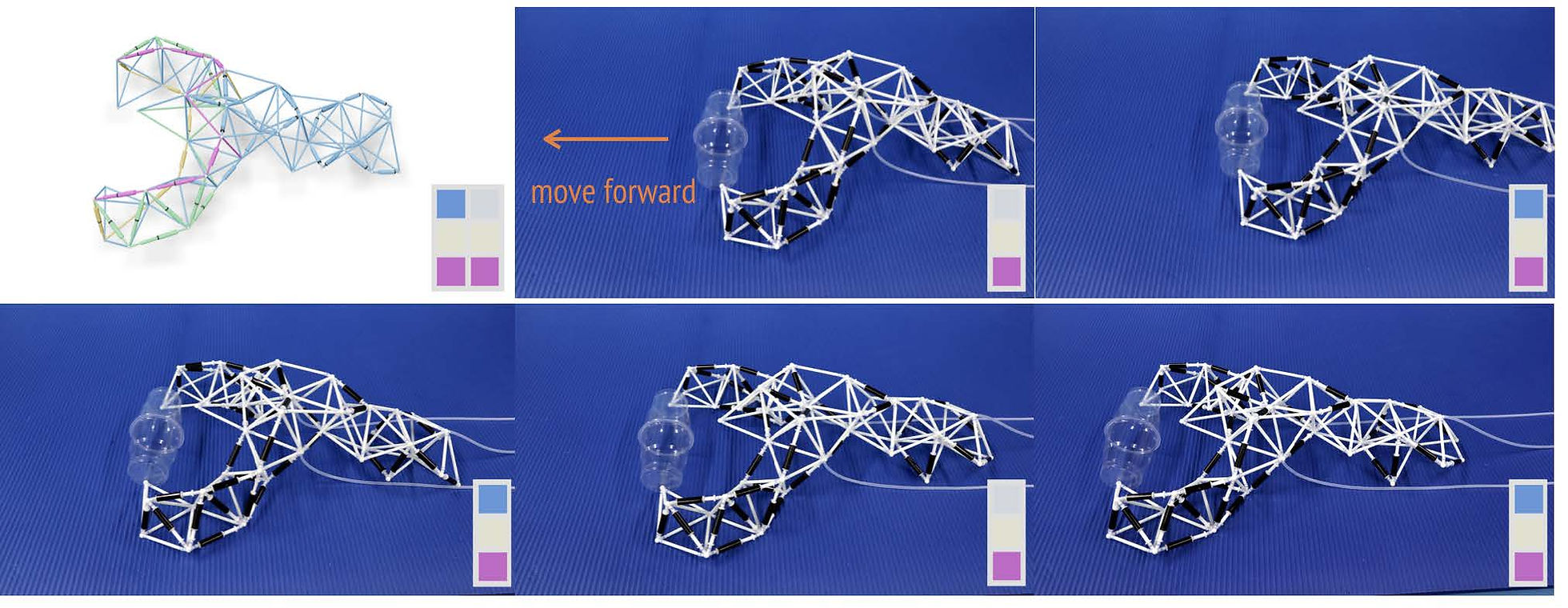
By manually switching the blockers of the yellow channel, the lobster can be switched between two modes. In each of the mode, by sending the actuation signal for different channels, the lobster can do 1) grabbing + slowly moving or 2) quickly moving.
Pill-bug

A basic crawling robot designed to move forward with three control channels. The bug uses crawling motion and gait to locomote on the ground.
Turtle
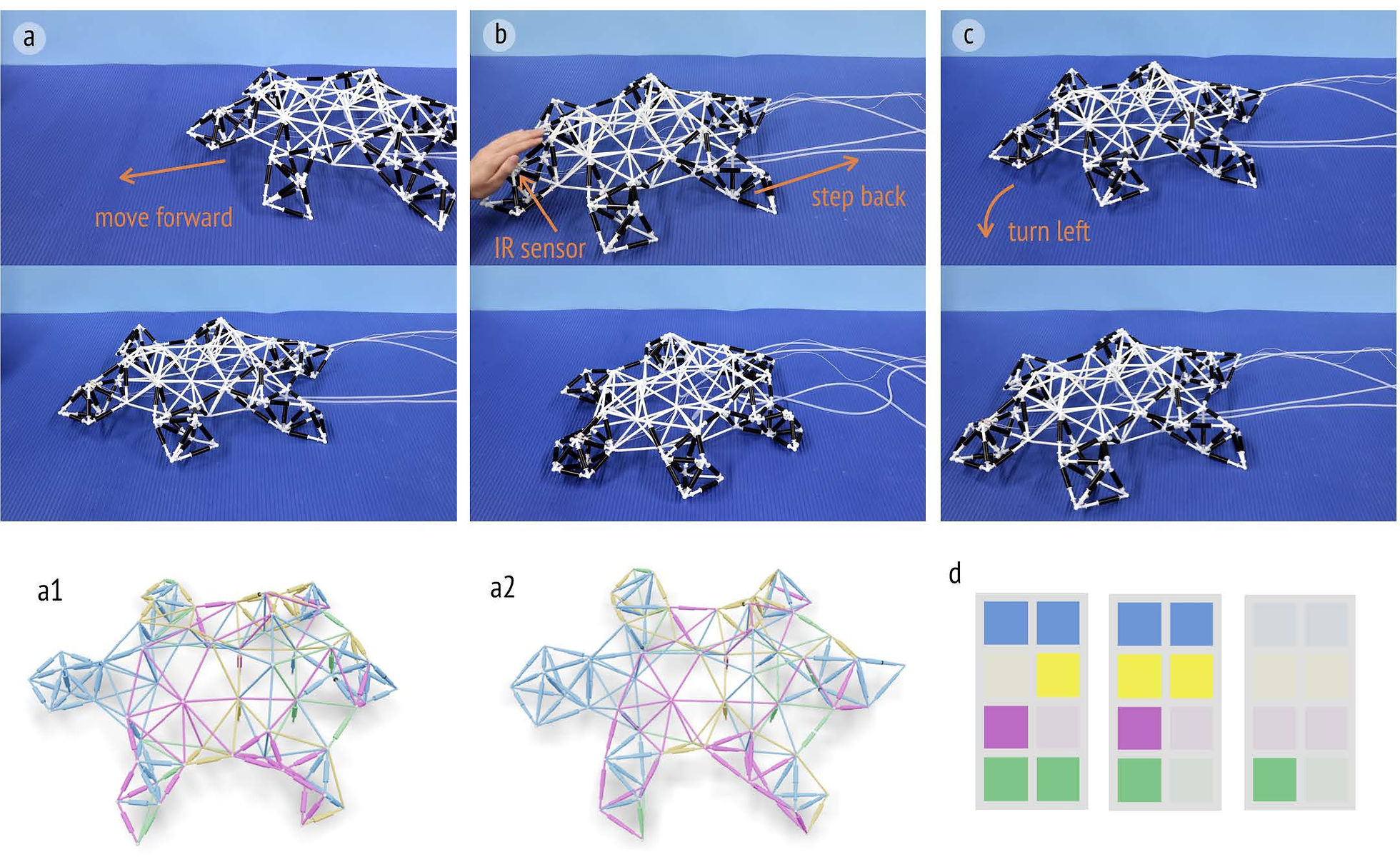
The turtle shows the capability of switching locomotion behavior by merely changing the control signals. In this case, neither the contraction ratio of the beams nor the initial geometry (physical assembly) has been changed. Additional sensors, such as an IR sensor, can be attached to the robot to make it interact with the human hand.
Fox
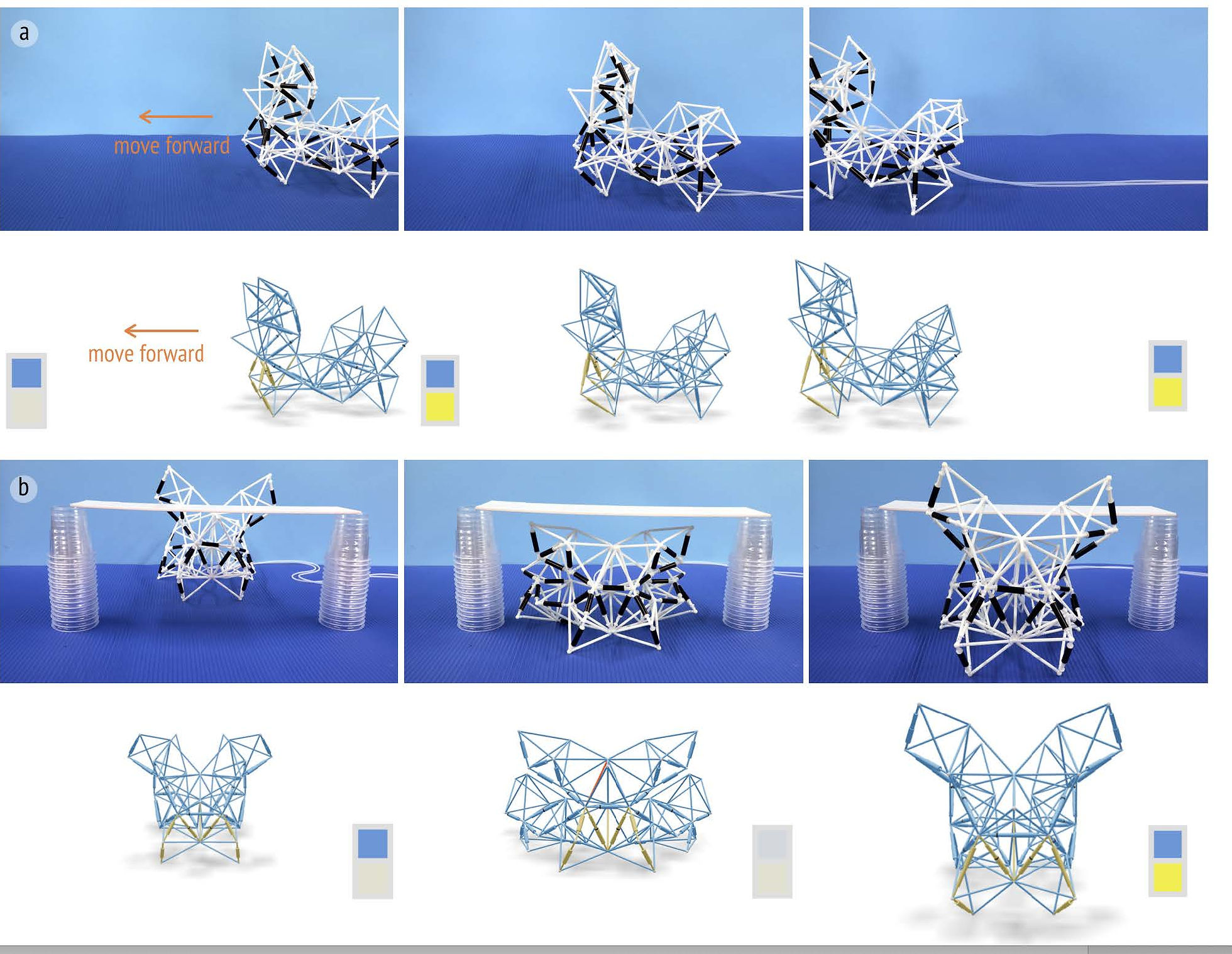
We implemented the fox to show the capabilities of switching transformation behaviors by changing both the contraction ratio of selective beams and the control signals.